Thursday, July 21, 2011

The Wait for Fans I: (Ali Krieger)

(Click any photo to see a larger version). While waiting around the game to dodge traffic, I noticed that several fans were running toward the second-level suites. Turns out that Ali Krieger, who did not play in the game, was there, and someone told the fans who she was. One aspect of women's soccer I find interesting is that unless you are told, you often don't know who is a fan or trainer, and who is a player. On the one hand, it encourages fans to think of players as real people. On the other hand, it means that there's not the natural aura one gets from staring, at, say, a Dwight Howard or Peyton Manning.


Fans look up at Ali while waiting for autographs.

I forgot just how excited young fans become when interacting with a star. Even with the blurriness of the photo, you can see the fan's smile as Ali Krieger signs her shirt.

I liked this photo for two reasons. You can see a little boy has also joined the girls in wanting an autograph (more on this later). Also, note the little girl with the soccer ball, apparently admiring an autograph she just received. Who knows if she herself will be a player some day?
Note the fan in the black top on the left. It's tough not to be nervous in waiting for an autograph. What if this adult athlete shuns you or has to go?
This might be my favorite photo in this blog. Ali was getting a bit tired at this point, but you can also see that the sweet request of the fan is endearing. I think at some point in our lives we've all been that fan holding up the slip of paper asking for an autograph.
I unfortunately did not get a photo of the fan as she left, but she and her friend were glowing. Click here for Part 2, in which Ali gets some unexpected (but needed) visitors in the autograph line...

The Wait for Fans II: (Ali Krieger)

Part I is here. As I was taking photos of Ali signing autographs, I noticed how typical the crowd was. Many young girls and their parents were trying to get an autograph. I once waited in an autograph line after a women's sports event and regretted it. Being the only male between 20 and 40, surrounded by screaming little girls and their parents, made me feel out of place. However, as I kept clicking away, something interesting caught my eye...
Two young guys ran up the steps to go get an autograph from Ali.


They started taking photos of her as they waited for their own autographs. You can also see a little boy at bottom left reaching up for an autograph, just as the girls are doing.

What is different about this photo than the others? It's dominated by men and boys. These guy fans wore pink headbands in honor of Alex Morgan, and I saw another guy who had his own handmade Alex Morgan t-shirt. In my opinion, the WPS needs to have this happen more and more often in order to survive. A cynic might note the rather crestfallen little girls waiting for their turn. But overall, I think a more diverse crowd will legitimize the WPS and keep it financially healthy.

In the end, you can see that the fans and player alike have joy from the interaction. Is it tedious? Did Ali Krieger's wrist hurt from signing so many autographs? Yes. But this is how leagues are built, unfortunately; one interaction at a time, multiplied over and over again until grassroots enthusiasm meets polished product and sophisticated marketing. Hopefully the wait will be rewarded for the WPS.

Wednesday, July 20, 2011

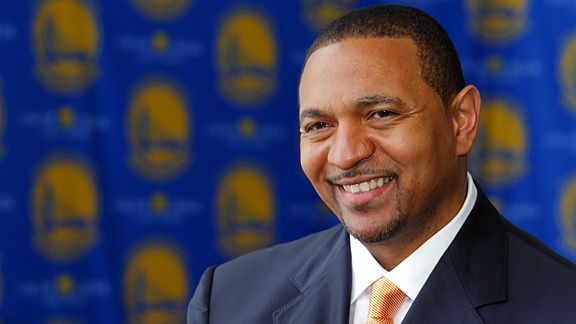
Mark Jackson and the Value of a Name


Rocky Widner/NBAE via Getty Images

When I heard that Mark Jackson was hired by the Warriors, I had to hide my disbelief. The point guard who ran some of the slowest offenses in the league would be now in charge of the fun-and-gun Warriors? The folks at ESPN agreed with me, as writer after writer tore into the Warriors for choosing Mark Jackson.

However, looking back at the records of star ex-players who became coaches, and TV analysts who became coaches, I'm surprised by how good those coaches became. The optimistic example for Mark is Doc Rivers, who only three years after his retirement was coaching the Magic. Kevin McHale and Larry Bird had zero assistant coach experience and still stepped in and did a halfway decent job. Also, analysts such as Hubie Brown and Doug Collins stepped in and got instant respect from their players. Honestly, I couldn't think of one analyst or player that was truly poor except for Magic Johnson. (I would have liked to see how Isiah Thomas would have done if Eddy Curry was healthy instead of hungry.)

The average NBA player would rather be coached by some guy that he's seen on TV rather than a guy who has been a no-name assistant for 20 years. The head coach doesn't need to be a star X's and O's guy himself. Being able to demand instant respect from the players the moment you walk in the door makes it much easier to wait out the inevitable player conflicts early on. It's why the NBA rarely works out for college coaches; they can't demand the same level of credibility. If Mark Jackson could handle the demands of Reggie Miller and Patrick Ewing, I think he'll be able to keep Monta Ellis under control. With a guard-heavy offense in Golden State and a strong compliment of assistants, I think Mark Jackson will be a shrewd hire.

Thursday, June 23, 2011

NBA Draft Preview: Beware of Kahn Bearing Draft Picks

Much like a loyal fan of a mediocre small-market franchise, I hunt draft articles voraciously for Derrick Williams speculation. It's rare that an NBA team with a top 3 draft pick so obviously invites trade offers. And even more tempting, the Timberwolves GM is supposedly one of the weakest in the NBA. The temptation of trading overrated big-name veterans for Williams must be overwhelming. But that's not as safe a bet as you may think.


However, before you become convinced that your team needs Derrick, the NBA draft of 25 years ago offers a sobering reminder of how such trades can pan out. And no, I don't mean Len Bias. The 76'ers thought they were giving Julius Erving one last chance at a championship by acquiring Roy Hinson from the Cavaliers in exchange for the #1 pick. Please do read this 1986 article on the deal. Cleveland was in total disarray, and had a part-time scout (Gregory) playing general manager because the GM had been fired. Half the NBA was trying to fool Cleveland into giving away Hinson. Gregory was so out of his league, he freely admits to the paper that "It was like when a sergeant gets killed in a war, and the private takes over." His reasoning about why he traded Hinson is extremely simplistic, as he randomly babbles about Daughtery's hands as a major reason for acquiring Brad Daughtery.

Hinson as well sounds like the perfect opportunity for the 76'ers to reload and take down Boston. He was willing to defer to the established stars on the Sixers. Imagine the pairing that Hinson (20 and 8 in Cleveland the year before) could have been with Barkley. George Karl, Roy Hinson's former coach, was so sure of Hinson's skill that he said
"Someday, he will play in an All-Star game. I've been wrong about other things in the past, but I don't think I'm wrong about that."


That said, I still think a team we haven't heard of yet will swoop in and trade for Derrick Williams at the last moment. Also, what kind of draft piece is this if I'm leaving out baseless, uninformed speculation? I apologize. The opportunity to balance out a team that has its best players all at about the same age is too tempting to pass up. It's complicated because many of the teams with depth have it at the point guard spot (San Antonio, Oklahoma City, etc.). However, I thought of a few candidates.

Think, for example, of the Memphis Grizzlies, who have the Conley-Gay-Mayo-Gasol group all closely linked together in terms of resign dates. Memphis has steadfastly promised they would not trade Gay, but how can they avoid doing so if they want to keep Gasol? Or even, believe it or not, the Dallas Mavericks, although they have very few real assets under their control long-term other than Dirk. Mark Cuban does adore his veterans, but there's a sort of simple logic in one of the oldest teams in the league making a deal with one of the youngest teams in the league. I think the Lakers are a terrible fit, but what about (wince) the Los Angeles Clippers? The Clippers offer of Kaman for Beasley and Flynn was rejected, but I wonder if Eric Gordon could be available. (He would have to be signed to an extension, however). The matchup problems that a Williams-Griffin combination would present are quite tempting. Finally, I realized that the New York Knicks are...oh please don't tell me you thought I was serious. Your thoughts?

Thursday, June 16, 2011

Is Terrelle Pryor's Value Too Low?


I read an article on Sports Illustrated web-site that ripped Terrelle Pryor's QB abilities. Don Banks, a good writer, valued Pryor as only being worth a 5th or 6th round draft pick in the upcoming supplemental draft. I might agree with Don if Terrelle had come out for the regular NFL draft. But I think that actually, some team will bid a low 3rd round or high 4th round pick for Pryor, due to some exceptional circumstances Don may have not considered.

Leverage in dealing for Kevin Kolb. Teams like the Cardinals are desperate for a quarterback, and are forced to wait until the lockout ends to try to deal for a new quarterback. If such a team can acquire Pryor, it creates the illusion of more depth at the quarterback spot. Such a team can then claim that they can get by with a veteran retread for a few years while waiting for Pryor to develop. This forces the Eagles to lower their price. If acquiring Pryor for a 4 means that a team need only offer the Eagles two second-round draft picks instead of including a first-round draft pick, it's well-worth it.

Added buzz for ticket sales for a dull team. After the lockout ends, teams may struggle selling tickets, especially if that team already had a bad reputation. The Bills, for example, had a smart draft where they avoided taking a QB and decided to stick with Ryan Fitzpatrick for now. However, Bills fans are very impatient with the team's losing style and lack of playmakers. Or, take Cincinnati, a team that had to blackout games last year. Think that such a team won't be tempted to take Pryor to boost ticket sales and lure in a few Buckeyes fans? It will also help create more competition for Dalton at a relatively cheap price.

Added playmaker for unconventional offenses. If the Dolphins were willing to spend a second-round pick on Pat White, why not spend a fourth-round pick on Pryor? For run-first teams with immobile, strong-armed QB's, why not bring in Pryor as an additional weapon? Yes, it's not exactly clear where Pryor best fits, whether QB or wide-out. But it's clear he has above-average skills. And that's enough to intrigue talent evaluators, who foam at the mouth at transition talents like Tebow, Matt Jones, Pat White, and others. Somewhere, there's a GM or coach who thinks they can use Pryor as a secret weapon, and they'll see him as a bargain.

The deceitfulness of scarcity. Imagine you are an NFL GM. The draft is over. You can't sign any undrafted free agents. You have next to nothing to do. There is literally ONE player in all of football that you can acquire. Don't you think some bored GM is talking himself into Terrelle Pryor as we speak, cackling as he thinks he will get an edge on the rest of the league? We all become bargain hunters when we think we got the last item on the shelf. Expect that instinct to persuade at least one GM to pay big for Terrelle Pryor.

Tuesday, June 14, 2011

Blogger Bias and The Curious Case of Deadspin's SportsWriting Fixation


Many bloggers justifiably complain about the way journalists treat us like children stuck in our mother's basement. But bloggers turn around and commit their own crime against sportswriters by insisting that every column sportswriters write must contain nothing but sports content. Heaven help the sportswriter who tries to write about something that doesn't involve a ball. Sportswriters are single-minded idiot-savants who are only capable of game recaps and sports cliches. Don't believe me about this bias? Let's take some Deadspin columns as an example.

Yesterday's debut of Tom Scocca at Deadspin.com contained the usual blogger initiation ritual of painstakingly proving why yet another writer is not bloggerly enough. (Naturally, I intend to follow him through the looking glass. Hypocrisy duly noted.) He dragged out Deadspin's Barbaro, err, favorite dead horse for yet another beating.

Tom decided to lecture us all on the dastardly sin of a writer not writing about sports. He assumes that we are all on Deadspin to read about sports, not his life. Tom clearly underestimates my desire to waste time by any means that won't get me fired, but I appreciate his high estimation of my principles. I'm also totally taking that yoga class just to improve my health. It's strange that as Deadspin contains less and less sports content (and higher and higher pageviews), they still fail to realize the trend elsewhere. Yes, I'll read about a sportswriter's life, if it's interesting and the alternative is a derivative game recap I've read elsewhere. Why wouldn't I?

Tom then asks us "In the week when the Mavericks were putting together the most unexpected Finals triumph since the Billups-Wallace-Wallace Pistons beat the Lakers, who needed an essay telling the story of how Wright Thompson dreamed of growing up to be a Writer and drinking in the Big City?" For Tom, Wright Thompson's major crime appears to be that he has not joined the herd of sportswriters using second-rate psychology and thinly disguised stereotypes to write the 10000th column about the NBA Finals. Wright Thompson is not writing about sports. Thus Wright Thompson must be lectured by Deadspin to be more sports-focused. Why?

I'm not exactly sure when it happened, but at some time Deadspin decided to kindly mentor confused writers and keep them focused on sportswriting. They are not alone in this, but I've noticed it so often that I started keeping track. A brief history of Deadspin's odd fixation with not allowing sportwriters to have any non-sports fun follows. I'll allow much of it to stand alone without commentary, and eagerly await your explanation as to why this tendency exists.

One of my favorite examples is this article by Jack Dickey admonishing writers for mentioning their own Japan experiences in articles. A sportswriter writes about the Japan disaster and mentions that she once lived in Tokyo as the reason for her interest in the story. But the defense of a writer wondering if her friends died isn't enough to dissuade Jack from bringing this non-sports writing monster to justice. He writes "But she is exploiting the disaster for her own ends just as surely as Pondexter was, even if their means of expression differ." Exploiting! As everyone knows, mentioning a hot news story on a low-traffic sports site is the ultimate SEO bait. There's no way such an article would get buried under 126234 CNN news stories. So Dickey's main problem is that a sportswriter writing about a non-sports topic would get more pageviews than usual? Interesting.

"Mitch Albom Is The Greatest Writer Who Occasionally Writes About Sports" (Title)
"He abandoned the art of lyrical game stories and statistical sidebars to write nu-religion feel-good-about-feeling-bad fiction and there's no reason that anyone else shouldn't follow him." --Dashiell Bennett

"Big Ben’s Woman Problems The Result Of Stunted Psychosexual Development, Says Guy Who Writes About Sports" --Tommy Craggs

"You might have noticed that this is more accurately a list of things that distract Bill Plaschke. Distract him, a sports writer, from having to come up with actual sports things to write about. Lamar Odom won't play poorly because he went on TV, and he won't overcome the adversity of said TV show to play well." "Barry Petchesky"

"Yes, Gladwell is an effortless writer who manages to only occasionally sound like a PowerPoint slide. And yes, he clearly knows his sports. But to say he might be our best sportswriter is to suggest he is, in fact, writing about sports, which he most definitely isn't. Sports are incidental to him, just the front end of another in a long series of tedious analogies, as often as not to management culture (basketball is batch processing!). As it is, we're up to our bow ties in slumming dilettantes seeking out tiny epiphanies in sports. The last thing we need is to start anointing another." --Tommy Craggs

So why are bloggers, particularly Deadspin, so angry when sportswriters fail to stick to sports? I thought Barry's words about Page 2 well-described why I like it when sportswriters do not stick to sports. I look forward to your comments as to why bloggers keep insisting sportswriters only talk about sports.
"But to do it with humor, to give talented writers a sandbox where they wouldn't be beholden to typical rules was something new. Remember, at this point, a web site was seen as a newspaper on a computer. It's not a stretch to say Page 2 was a muse for a generation of sports bloggers, unconstrained by the need to write a nutgraph, or even about sports at all. It was a template of irreverence." --Barry Petchesky

Friday, February 25, 2011

NBA Trades and Traps

Yesterday's trading deadline led to a lot of last-minute excitement, and I've been devouring blogs ever since trying to read all the analysis. Here are a few points that stood out to me:

Welcome to 2011, NBA offices! Believe it or not, in this day and age, the NBA still requires teams to call in trades, and only has one line for them to do so. Naturally, several teams are calling at 3PM, which led to this amazing paragraph from the Indianapolis Star about the voided trade for OJ Mayo:
"Sources told The Star, though, that the Pacers called the league at 3 p.m. to notify them of the three-team deal, and were on hold, waiting to get into the league's queue, when the deadline passed at 3:01 p.m. While the Pacers were waiting, New Orleans apparently backed out of the deal -- which wouldn't have been consummated anyway, since the league insisted it was 3:01."
You're telling us that the fate of multi-million dollar trades are in the hands of...a phone queue? NBA teams can't email in trades before 3:00 PM? Really? The office can't do a little verification to make sure that Bird324236@aol.com is really Larry Bird and then let him email in a trade?

I had hoped, in an age of more voices and choices, that people would stop pretending that Mark Cuban is a voice of reason in the NBA wilderness. He somehow managed to convince many writers that his having to pay the prorated salary of Carl Landry was "wrong every which way" according to this ESPN article. But let's run the numbers on how much personally comes out of Mark Cuban's pocket for this deal. The difference in salary is 2,240,000 million, pro-rated. Given that most teams have already played about 59 games, that means that the Hornets must only pay 23/82 of Carl Landry's salary. Now, Mark Cuban is personally responsible for 1/29 of that. Roughly, that means that Mark Cuban is shelling out 1% of 2.24 million, which is...are you ready? $21,655. I would bet many of you make more than that each year. THAT is the amount Mark Cuban is complaining about paying. Seems like Cuban's generosity has died out quite a bit since hosting "The Benefactor"-and since no one remembers what that is, here's a link.

Finally, a quick note about an underrated winner of draft day deals. By trading Billups and Anthony, Denver has eliminated two of its slowest, most methodical players from the lineup. The point guards are now Felton (taught in D'Antoni's offense) and Lawson, well-known for his quickness. A quicker team with a deep bench, playing in the high air of Denver, coached by a guy who has struggles with stars but gets a lot out of deep teams. I'm not quite crazy enough to predict a play-off upset, but might this Denver team be able to wear out the older Lakers, Spurs, and/or Mavs in a first-round series and push a series to 6-7 games? And what would that mean for the Thunder, if given the opportunity to play an already weary veteran team in Round 2? Let me know how crazy this idea is in the comments.